Creating a Culture of Calm
Hygg-Ed
Creating a Culture of Calm | Menopause in the Classroom | Back to Basics
"Caring for Those Who Care for Others"
The Calming Classroom
Global CPD Session
Available in-person, live online, or as a
Pre-Recorded Digital Download.

This training is not a guide on classroom interior design, Pinterest-inspired display boards, or even how to bring hygge into your setting.
This extends far beyond aesthetics to the deep psychological, emotional, and physical effects that the physical environment has on us as individuals.
The Reality of Environmental Triggers
As an educational practitioner of twenty-five years, I know that modern classrooms are quietly exhausting our school communities. We often focus heavily on curriculum targets, completely blind to the silent physical stressors built directly into the four walls of our settings.
My own daughter struggles with severe allergies. Harsh, bright classroom lighting acts as a direct physical trigger for her symptoms, leaving her suffering so badly that it's led to substantial school absence. She knows that stepping into that specific sensory environment will make her feel physically unwell. This isn’t a refusal to learn, she’s as bright and keen as a button, but it’s a physiological environmental barrier that drives long-term pupil absenteeism for her and so many others like her.
Not Just for Children
It isn’t only the children who can be affected in this way. I watched a wonderful former colleague battle insufferable migraines caused by the relentless classroom glare. She was forced to turn off every light during breaks and work at her desk wearing a pair of sunglasses so large that you could barely see her face!
She didn’t do it to make a point, it’s what she had to do just to survive the working day and know that she could go home and make the most of the evening with her family rather than going straight to bed to sleep it off. The sensory exhaustion was so severe that she eventually left her role feeling completely burnt out, and what's more, she isn’t the only educator to have experienced this, which is really not okay.
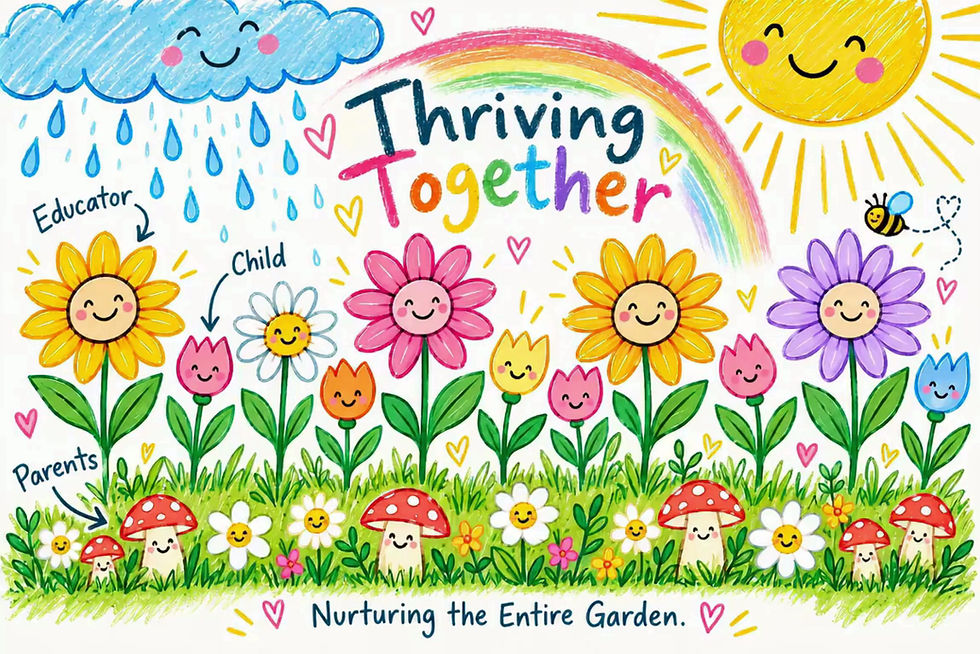
Picture the educators and the children standing side by side, looking up for nourishment together. When the sun shines on them and refreshing water falls upon them, something incredible happens - both the educators and the children thrive, blossoming in equal measure, and what about the parents? They are the flower bed, the soil supporting the flowers in bloom and they are so incredibly happy!
Why? Because even though they aren't directly standing in that immediate sunshine or rain, they are getting exactly what they need. The nutrients and minerals are trickling down through the vibrant flowers, leaves, and deep roots of the thriving flowerbed above, feeding the entire family ecosystem perfectly.
Surely it is time to put the needs of educators on an even par with the children? If educators are not thriving, there is absolutely no way they can be the best version of themselves, and that depletion will always have a negative impact on the children in their setting.
Reshaping the Pyramid
In today's educational world, an immense amount of pressure is placed on keeping parents happy - especially when parents are paying customers. We constantly aim to work within a pyramid-shaped partnership between parents, educators, and children, but is this truly sustainable in every aspect of our work?
Sometimes we need to flatten the pyramid and recognise those who are sharing the space every moment of the day.
So what if we reshaped how we look at our settings? There are only two sets of people who are in the classroom on an hourly - not daily, but hourly - basis: the educators and the children.
It's time to move things around, make the needs of both groups equal, and place them side by side.
Imagine the classroom is a garden. For too long, we have tried to water the garden by prioritising external pressures.
Let's look at our classroom as a
'Garden of Growth'.
The Science of the Space Within
Nobody needs to become an environmental scientist (I know, I’m not!), but we must understand the biological reality of our classrooms. Medical research proves that the high-frequency, completely imperceptible flicker of harsh fluorescent classroom lighting, acts as a direct central nervous system stressor.
-
For Pupils: This constant neurological stimulation can trigger Mast Cell Activation, chronic headaches, and physical histamine or allergy flares that force children into long-term absence.
-
For Staff: The relentless sensory glare causes severe migraines, cognitive fatigue, and eventual workplace burnout, driving dedicated teachers out of the profession entirely.
A school health and safety policy is an important starting point, but a piece of paper alone doesn't change the physical environment. Our training program is designed to cultivate a genuine culture of somatic safety, giving leadership teams actionable, systemic strategies to lower absence rates and protect the adult nervous system.
The Calming Classroom
The Modular Framework
The 7-Module Curriculum | What's Covered
-
Module 1: Reshaping the Garden: Moving out of the exhausting parent-pyramid. Understanding how to place educator and child needs side by side on an even par to stop systemic classroom depletion.
-
Module 2: The Science of the Flicker: Unpacking the physiological impact of high-frequency lighting and environment triggers on Mast Cell Activation, histamine responses, and chronic pupil absence.
-
Module 3: Beyond the Sunglasses: Identifying staff sensory overload, recognising hidden environmental stressors, and permanently breaking the cycle of workplace environmental trauma.
-
Module 4: Somatic Safety: Simple, low-cost physical adjustments to protect the central nervous system from environmental exhaustion without remodeling your budget.
-
Module 5: A Successful Filter System: How prioritising the daily hourly experience of staff and children can satisfy inspection frameworks, school boards, and parents.
-
Module 6: To be, or not to be? (For that is the question!): Looking at our learning environment with a fresh perspective and systematically seeing what we need and what we don't need. This isn't about turning our backs on Pinterest class makeovers (they look amazing!), but seeing things objectively and moving toward unhurried, cognitive-friendly learning environments that reduce daily friction.
-
Module 7: Passing the Reins: This final module equips your setting with the official Hygg-Ed Environmental Audit Matrix so your staff can independently evaluate their use of lighting, acoustics, and sensory inputs. We provide the blueprint; your team takes the action to solidify a lasting culture of calm. This module can be part of the formal Hygg-Ed Accreditation programme.